How the Exit Traveler worked
A portable descent device for lowering one person from an upper floor when ordinary exits are blocked, as described by the press and by the original Exit Traveler website.
How it worked
- Anchor the hook. Place the steel hook around a heavy, stable object, such as a bathroom fixture or bed (Newsweek) — a pipe, a bed, a desk or another heavy support object (Manila Standard). A tie-down cable was supplied for when nothing suitable was nearby.
- Put on the harness. The adjustable harness, or rescue sling, fits under the arms.
- Climb out. Exit through the window or balcony, then “all the user needs to do is hang on” (Newsweek).
- Descend at walking pace. The cable unwinds from a cassette with spring-loaded brakes; the braking action increases with weight, so descents run at about the same speed whatever the person’s weight.
Sources: Newsweek, October 26, 1987; Manila Standard, November 27, 1988.
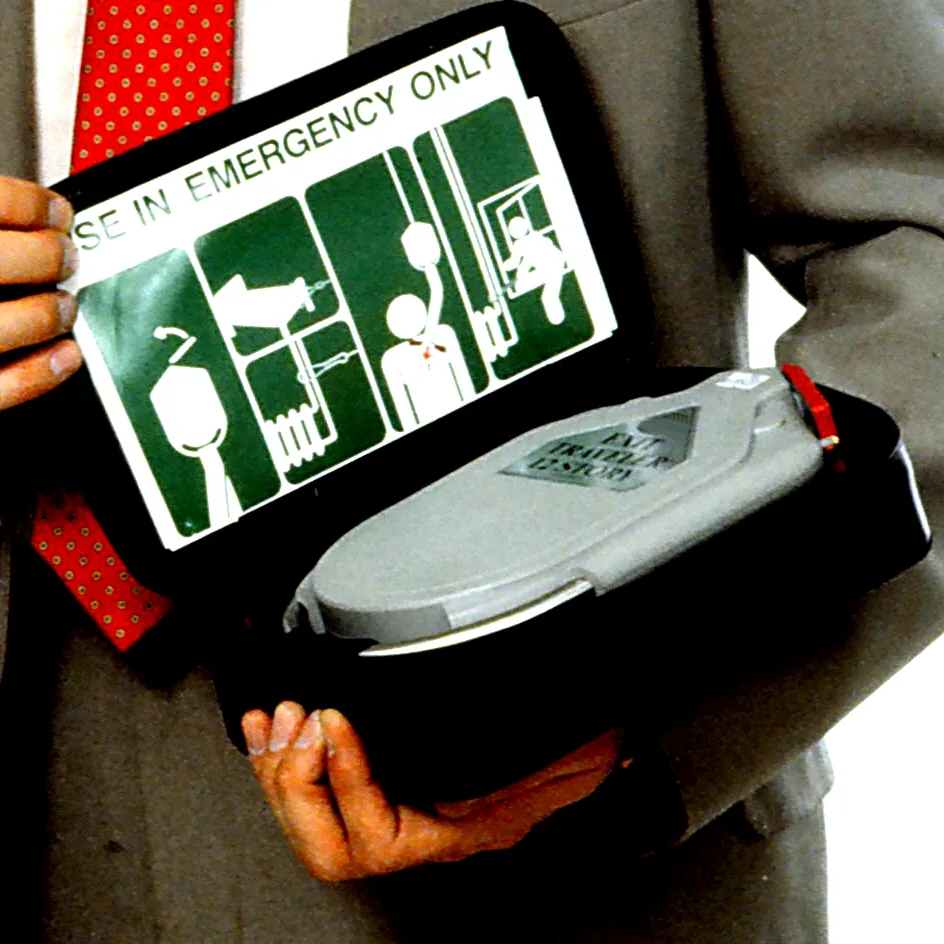
The Exit Traveler in its carrying case, with the pictorial emergency-instruction panel on the lid. Promotional photo, 1987.
Inside the unit: the “X-ray” view
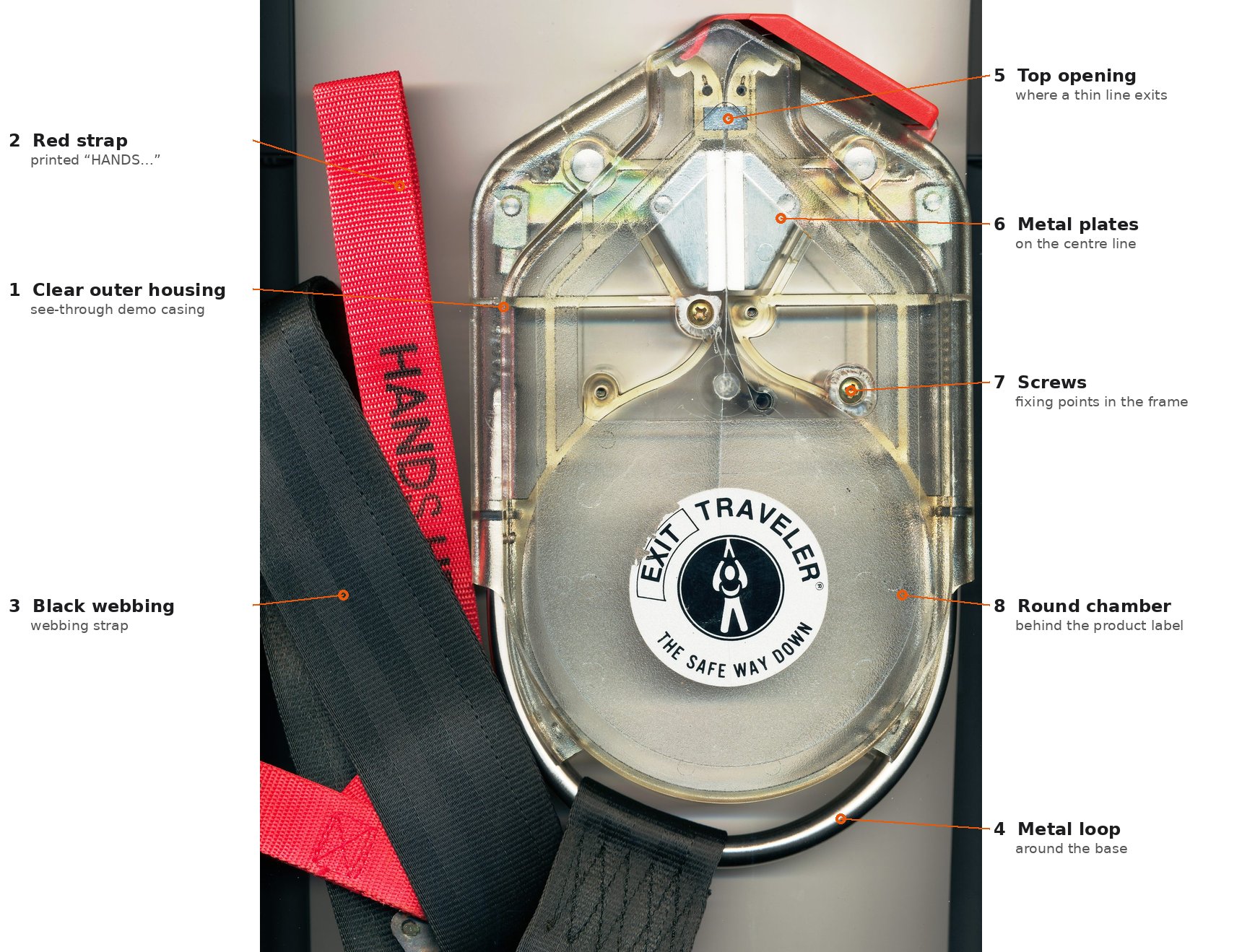
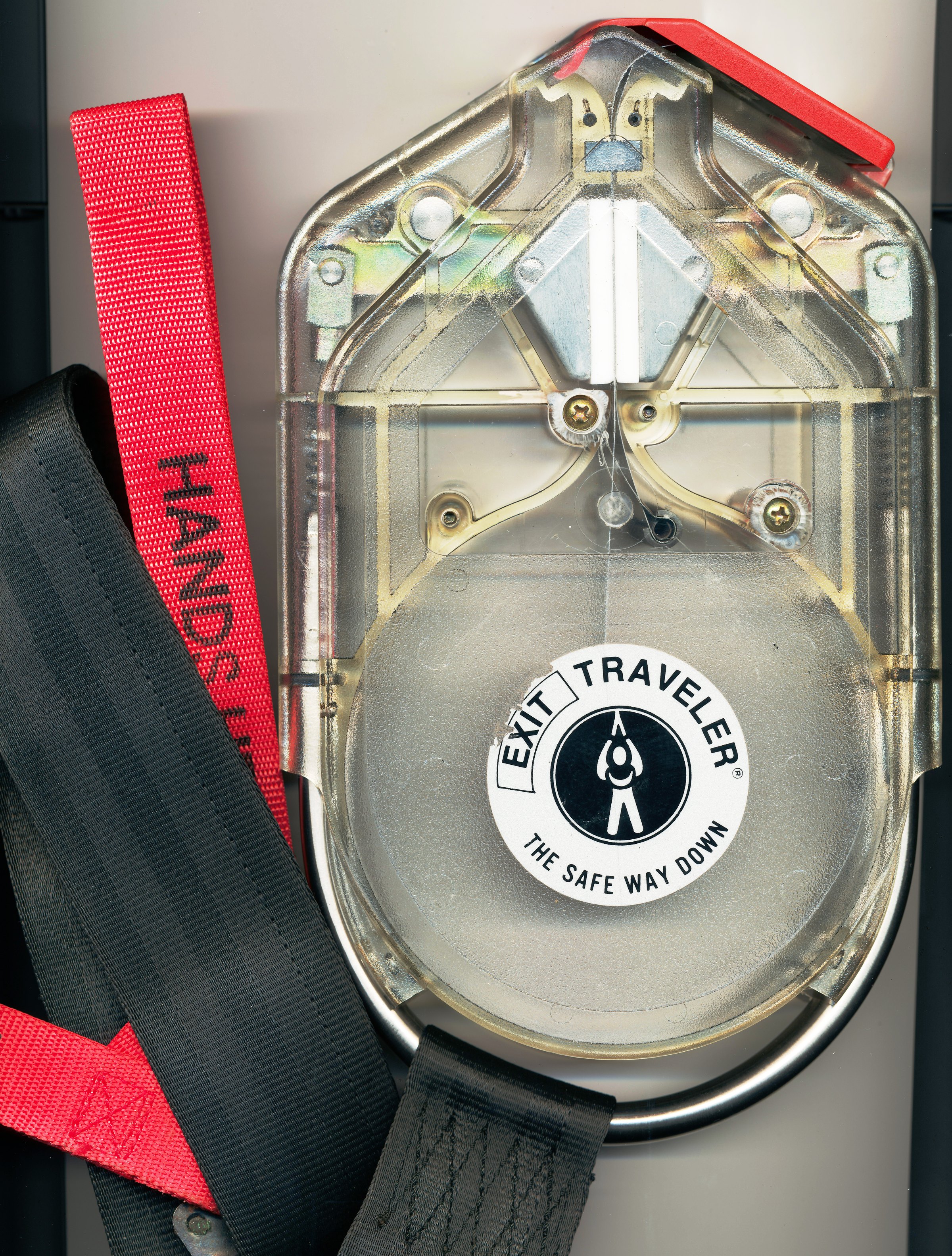
Two images show the inside of the unit: a close-up of a clear demonstration model, with a see-through housing in place of the usual grey casing, and an X-ray view of an Exit Traveler unit.
The X-ray view
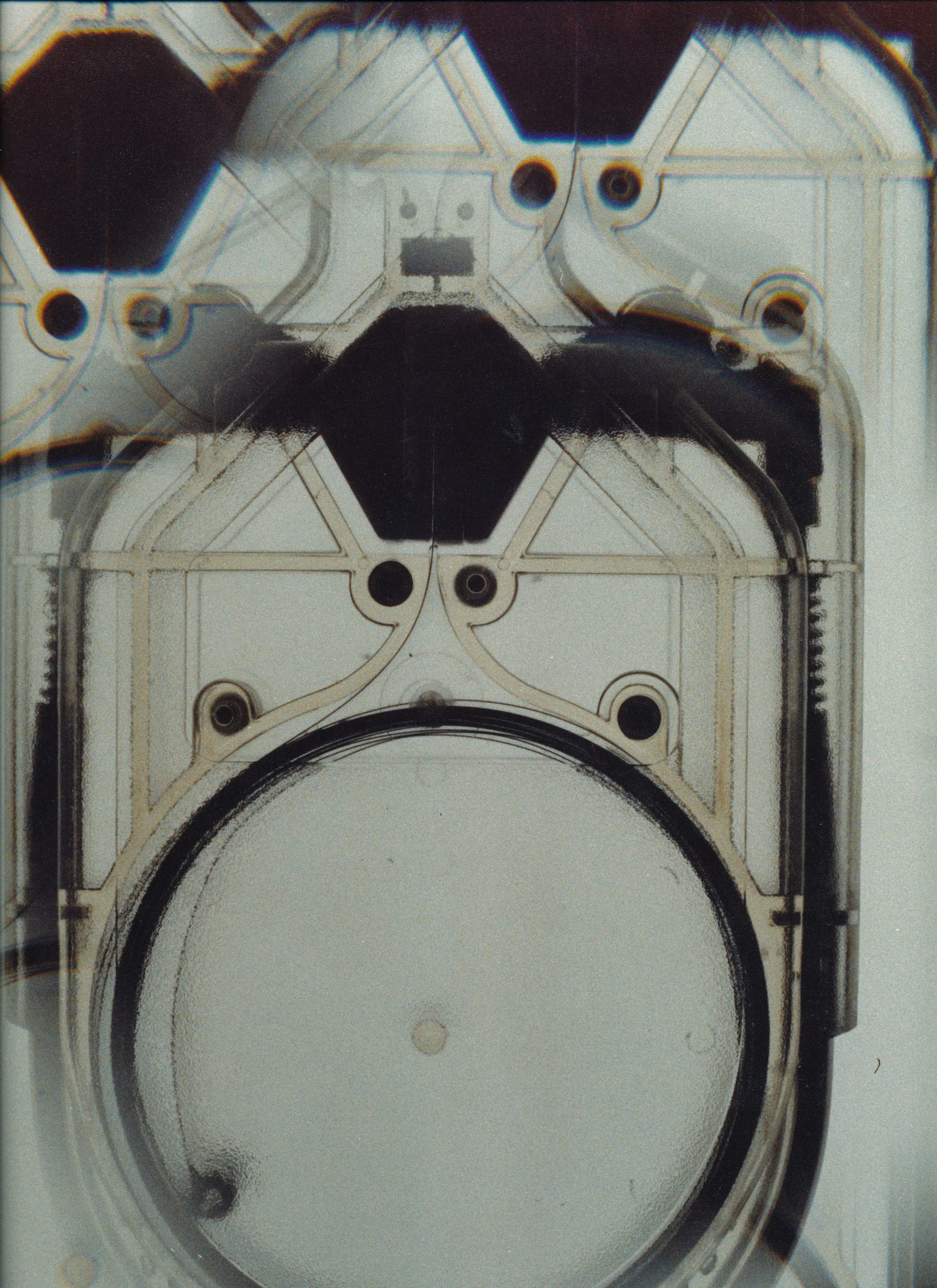
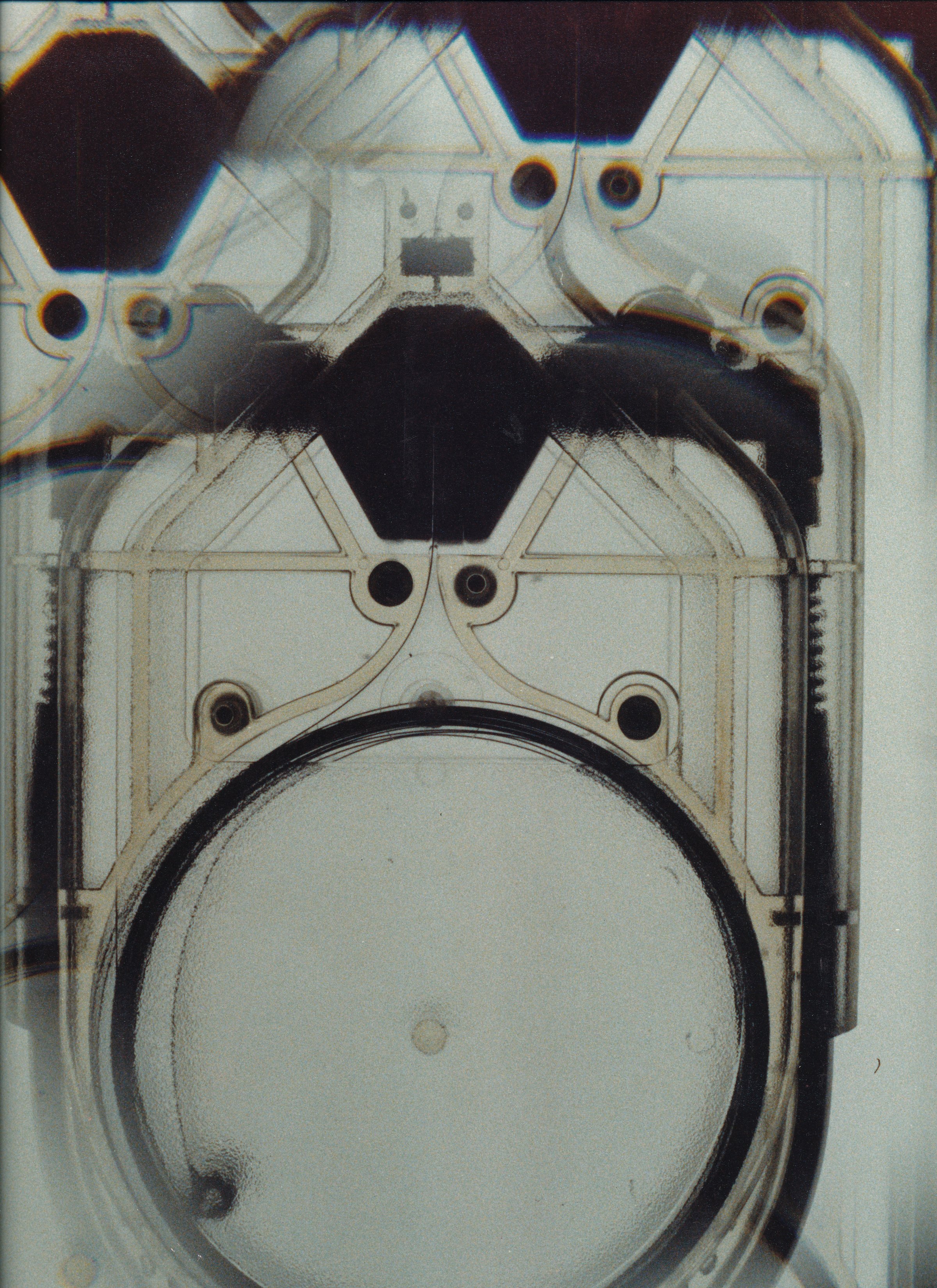
What can be seen in the X-ray: the moulded internal frame, with its ribs and round screw fittings; dark, six-sided shapes in the upper part of the unit; and the large round tape cassette filling the lower half, with a dark band around its rim. A dark band also runs up the right-hand side of the frame from the cassette toward the top.
The cassette in this X-ray view is empty in the middle: it does not have the 136 metres of stainless steel HD tape that was coiled inside a working unit (Rick Denzien). At the top, under the red tab, is the reinforced eyelet for hooking up the supplied carabiner and stainless steel cable (Rick Denzien).
What the X-ray view shows
- Housing and frame (1, 7). The clear outer housing has a pointed top and a rounded base. Moulded ribs inside form a frame, with screws and round fittings set into it.
- The round chamber (8). A large round chamber takes up the lower half of the unit, behind the round “Exit Traveler — The safe way down” label. Its contents cannot be made out through the cover in this photo.
- The top opening (5). A thin line runs up the centre of the housing from the area above the chamber to a small opening at the point of the top. It appears to be the path the cable takes out of the unit.
- Metal plates on the centre line (6). Two metal plates, with white strips between them, sit on either side of that path. They appear to guide the line as it leaves the unit. The photo alone does not show which parts make up the brake.
- Loop and straps (2, 3, 4). A metal loop runs around the base of the housing. A black webbing strap and a red strap printed “HANDS…” lie beside the unit; the full wording on the red strap is not visible.
How this fits the published descriptions
Newsweek described the unit as an exit “cassette” from which a fire-resistant stainless-steel cable “automatically unwinds,” with “two spring-loaded brakes inside the exit cassette” so that people of different weights descend at about the same speed, because “the braking action increases with an increase in weight” (Newsweek, October 26, 1987). The original Exit Traveler website spoke of “a fireproof steel tape,” and the Manila Standard of an “automatic brake” giving “a slow steady walking pace” (Manila Standard, November 27, 1988). The round chamber appears to be where that cable or tape was stored, and the opening at the top appears to be where it came out. These are readings of the photo, not statements from the sources.
In Rick Denzien’s words
Rick Denzien’s own explanation of the mechanism is coming soon.
Background: High-rise fires and rescue, a summary of why fires above the reach of ladders are so hard to escape and fight.
R.A.W. improvements
When R.A.W. took over the technology and know-how, it set about improving the Dutch design for U.S. production. Rick Denzien proposed several of the changes, and his partner Win VanBasten drew the specifications and sourced the parts.
- Smoother steel tape. The Dutch tape had very sharp edges that could cut someone or snag more easily. On the American version the edges were chamfered and smooth, so the tape felt rounded to the touch.
- Stronger, thicker, stretchier tape. Win found a stronger stainless steel that could stretch a relatively long way, and the tape was made thicker. The result was stronger, thicker and stretchier than the Dutch tape.
- Preloaded brakes. The original Dutch units had a moment of free fall before the cantilever brakes kicked in. The brakes did then adjust to the weight of the person in the harness, and the descent was fairly constant across a wide range of weights. Rick asked why the brakes couldn’t be preloaded with small springs and pointed to the exact spot on each side where they should go. Win took it through procurement, and the change was made.
- Simpler brake shoes. In the Dutch version each brake shoe was drilled for two spring pins that had to line up with two holes in the brake pad material. Rick suggested a lip on the leading edge of the shoe to hold the pad in place without the drilling. Win drew up the specs, and the design was changed.
- A cap that snaps back. Once the red cap on the Dutch unit was popped open, it could not be put back. Since nobody buys a $500 device without popping the lid, R.A.W. kept the fire-extinguisher-style eyelet pin, and Win redrew the cap so it snapped back in place.
- Sealed against tampering. The steel tape was wound so tightly in the cassette, with so much hoop force, that pushing even an inch of it back in was extremely difficult. R.A.W. warned against opening the unit and pulling the tape out, and sealed the whole unit in a thick, somewhat flexible translucent shrink plastic with a warning sticker.
Source: Rick Denzien, personal communication, October 27, 2026.
What was in the kit
- Steel safety hook, fire-resistant stainless-steel cable and rescue sling or harness — Newsweek, October 26, 1987.
- A tie-down cable for use if there is nothing to hook onto — Newsweek.
- A leather travel case and an automatic window breaker for windows that do not open — Manila Standard, November 27, 1988.
- According to the promotional video: harness and hand grips, safety hook and tie-down cable, an automatic window breaker, an emergency light stick and picture instructions (see Video).
Specifications, as reported
These figures come from different press items and a promotional video. They are quoted as published, and reports differ.
| Item | As reported | Source |
|---|---|---|
| Models | Four-, seven- and 12-story models. The 12-story limit was chosen, Rick Denzien told Newsweek, because that kit “is not inconvenient to carry around.” | Newsweek, Morning Call, Popular Science |
| Reach | “Over 12 stories” (original Exit Traveler website); 12 stories (Newsweek); “any building as high as 21 floors” (Manila Standard, Nov. 1988). | Newsweek, Manila Standard, the original Exit Traveler website |
| Descent speed | About half a meter per second (Newsweek); 1.64 feet per second (Morning Call, Manila Standard); 18 inches per second (Popular Science). Newsweek: 12th floor to the ground in 80 seconds. The video says about two minutes for 12 stories. | Newsweek, Morning Call, Popular Science, video |
| Weight range | 20 to 150 kilograms (44 to 300 lb in the video). More than one person could descend together if the total stayed within 150 kg. | Newsweek, video |
| Brakes | Two spring-loaded brakes inside the exit cassette; “no free fall” (Newsweek). See R.A.W. improvements on the preloaded brakes. | Newsweek |
| Use | One use only per unit (Newsweek). Rick Denzien writes that the “one time use” design made demonstrations difficult and expensive; his partner devised a way to demonstrate a single unit repeatedly at trade shows. | Newsweek; Rick Denzien |
| Size and weight | “The weight and size of a notebook” (Manila Standard); a 10-by-6-inch unit (Popular Science); the 12-story kit weighed four kilograms (Newsweek). | Manila Standard, Popular Science, Newsweek |
| Origin and testing | The Exit Traveler was originally made in the Netherlands (Morning Call). R.A.W. Rescue Products later bought the patents, production rights and know-how and began U.S. production in Ambler, Pennsylvania (Rick Denzien), with Rick’s product changes implemented by Win VanBasten. The Manila Standard item says it was patented in the United States and tested by independent laboratories including the National Test Institute in the Netherlands. The lowering device is covered by U.S. Patent 4,588,046 (1986), which names the Dutch developers Abram P. van der Neer and Harm W. Holman as inventors and was assigned to R.A.W. Rescue Products in 1988. | Morning Call, Manila Standard, Rick Denzien, Patents |
| Price | $398 for the 12-story kit, as listed in 1987 and 1990 (U.S. dollars). | Newsweek, Popular Science |
| Permanent version | R.A.W. also had similar products working up to 100 floors that were permanent, not portable. | Newsweek |
Prices are historical and are shown for the record only.
More: the original patent drawings, the 1985 Dutch press and further magazine pages and advertisements, 1987–1990.