Developments to Watch: the Exit Traveler
A “Developments to Watch” item on the Exit Traveler, credited to Rescue Associates Worldwide (RAW) of Ambler, Pa., with sales figures and corporate buyers.
Citation: Business Week, September 18, 1989. “Developments to Watch,” edited by Naomi Freundlich, p. 123. Found via Internet Archive.
What it says
- Calls it “a safety harness attached to a long steel belt” that lowers a person “from as high as the 12th floor,” and says “a longer, 36-story model is in development.”
- “Smaller than a phone book and weighing under eight pounds, the escape device costs about $400.”
- Says RAW “has sold 4,500 Exit Travelers via mail and [spec]ialty stores” and that companies including KLM Airlines, [Hei]neken and Shell Oil bought them for executives in high-rise offices.
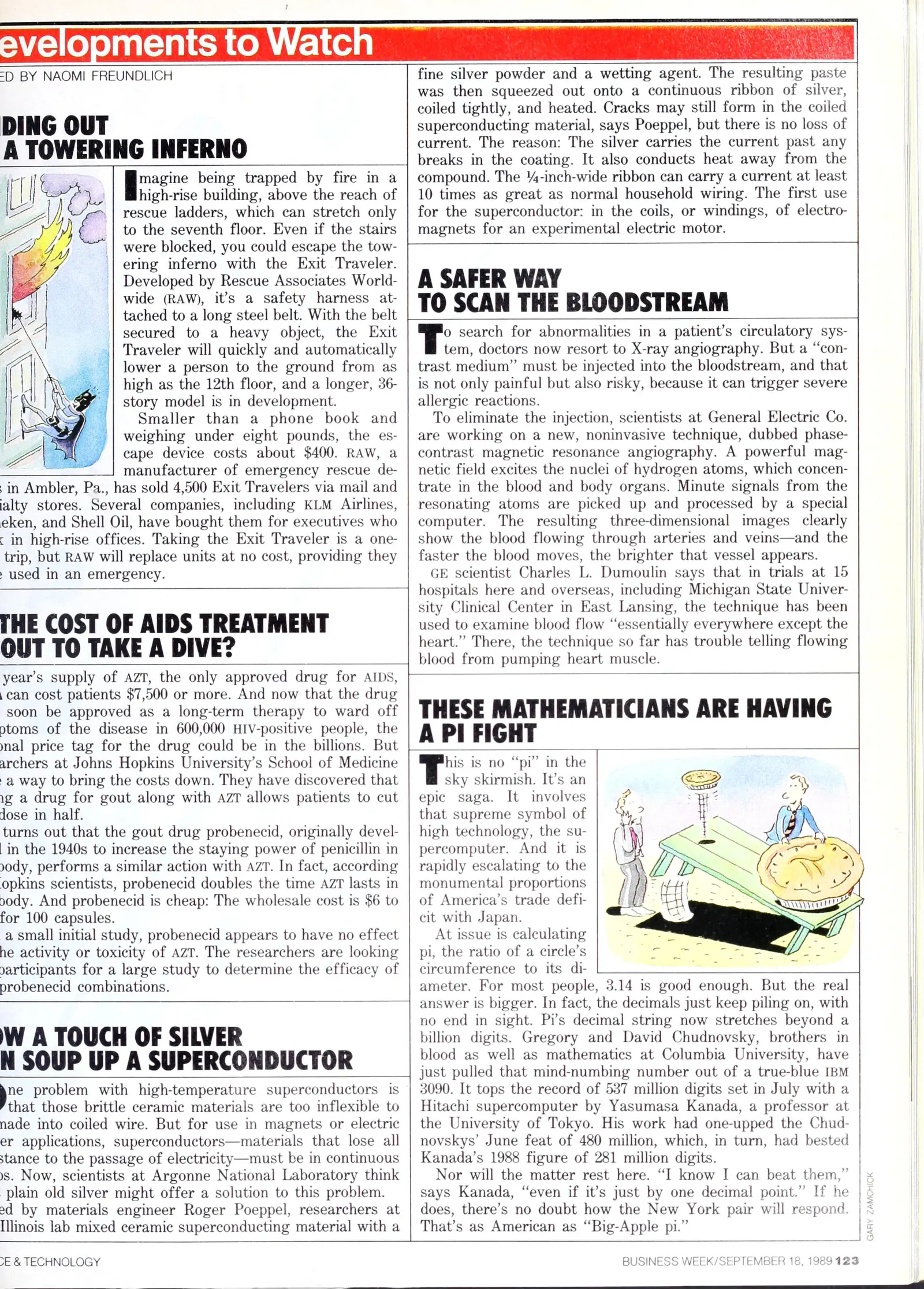
Page image from the Internet Archive’s scan of Business Week. The left edge of the page is lost in the binding; letters in [brackets] are our reading of the cut-off words.
Transcript
[Headline, partly cut off at the binding:] …DING OUT / …A TOWERING INFERNO
Imagine being trapped by fire in a high-rise building, above the reach of rescue ladders, which can stretch only to the seventh floor. Even if the stairs were blocked, you could escape the towering inferno with the Exit Traveler. Developed by Rescue Associates Worldwide (RAW), it’s a safety harness attached to a long steel belt. With the belt secured to a heavy object, the Exit Traveler will quickly and automatically lower a person to the ground from as high as the 12th floor, and a longer, 36-story model is in development.
Smaller than a phone book and weighing under eight pounds, the escape device costs about $400. RAW, a manufacturer of emergency rescue de[vices] in Ambler, Pa., has sold 4,500 Exit Travelers via mail and [spec]ialty stores. Several companies, including KLM Airlines, [Hei]neken, and Shell Oil, have bought them for executives who [wor]k in high-rise offices. Taking the Exit Traveler is a one-[…] trip, but RAW will replace units at no cost, providing they [are] used in an emergency.
Transcribed from the page image for accessibility and search; the scan is the document of record.
Reproduced as a historical document. Copyright remains with the publisher: Business Week (McGraw-Hill).